Freedom of Information (Part One of Two)
A how-to guide on requesting access to your personal information and why it’s important

Leiada Krozjhen


Your browser window currently does not have enough height, or is zoomed in too far to view our website content correctly. Once the window reaches the minimum required height or zoom percentage, the content will display automatically.
Alternatively, you can learn more via the links below.
This is the first of a two-part series on Freedom of Information (FOI), (also called Right to Information). In this part, we explain why FOI is important and how to lodge an application for information.
Prison authorities regularly make decisions for individuals in prison. These include for case management, prison transfers, parole and community supervision, and the need to participate in rehabilitation programs. These decisions must be justified by the information the authorities hold or have access to. Prisoners subjected to these decisions often do not know what information has been used to make these decisions and, therefore, may not know whether that information is incomplete or incorrect.
The specific information that prison authorities use to make decisions may include prisoner case notes and behavioural reports, clinical pre- and post-treatment reports, findings and recommendations from your initial intake interview, even records of past decisions. If this information is either incomplete or incorrect, then a decision made as a result may be inappropriate.
You may have a right to access some or all of this information under Freedom of Information. Each state and territory has its own Act that covers your rights and processes on information held by government departments. These laws can allow individuals to access their personal information. There are, however, some circumstances where information may be exempt from being provided to you, such as when it includes personal information of others or when disclosure would be contrary to the public interest.
In most situations, the information that prison authorities have is likely complete and correct. However, if you are subjected to a decision that does not seem appropriate, then it may be that there is something wrong with the information considered to make that decision. This is where Freedom of Information (FOI) processes can assist.
Incomplete or incorrect information may be the result of many things. It could be caused by a genuine mistake. It could be that information has changed over time and was not updated on certain records. Or it could be caused by incompetent record keeping or even something sinister.
No matter the reason, decisions made from incomplete or incorrect records can have a significant impact on you.
Freedom of information processes also provide avenues to update or correct that information if required.
Freedom of information processes vary across each jurisdiction. Most jurisdictions provide a pre-made application form to assist with making an application.
Any person in prison seeking to make an application should first ask prison management whether there is a pre-made form for applications. If there is no pre-made form, then people can simply write a letter to request information. Your letter must contain:
See the following table for the address to send your application. This address can also be used for general inquiries about the processes for accessing your personal information.
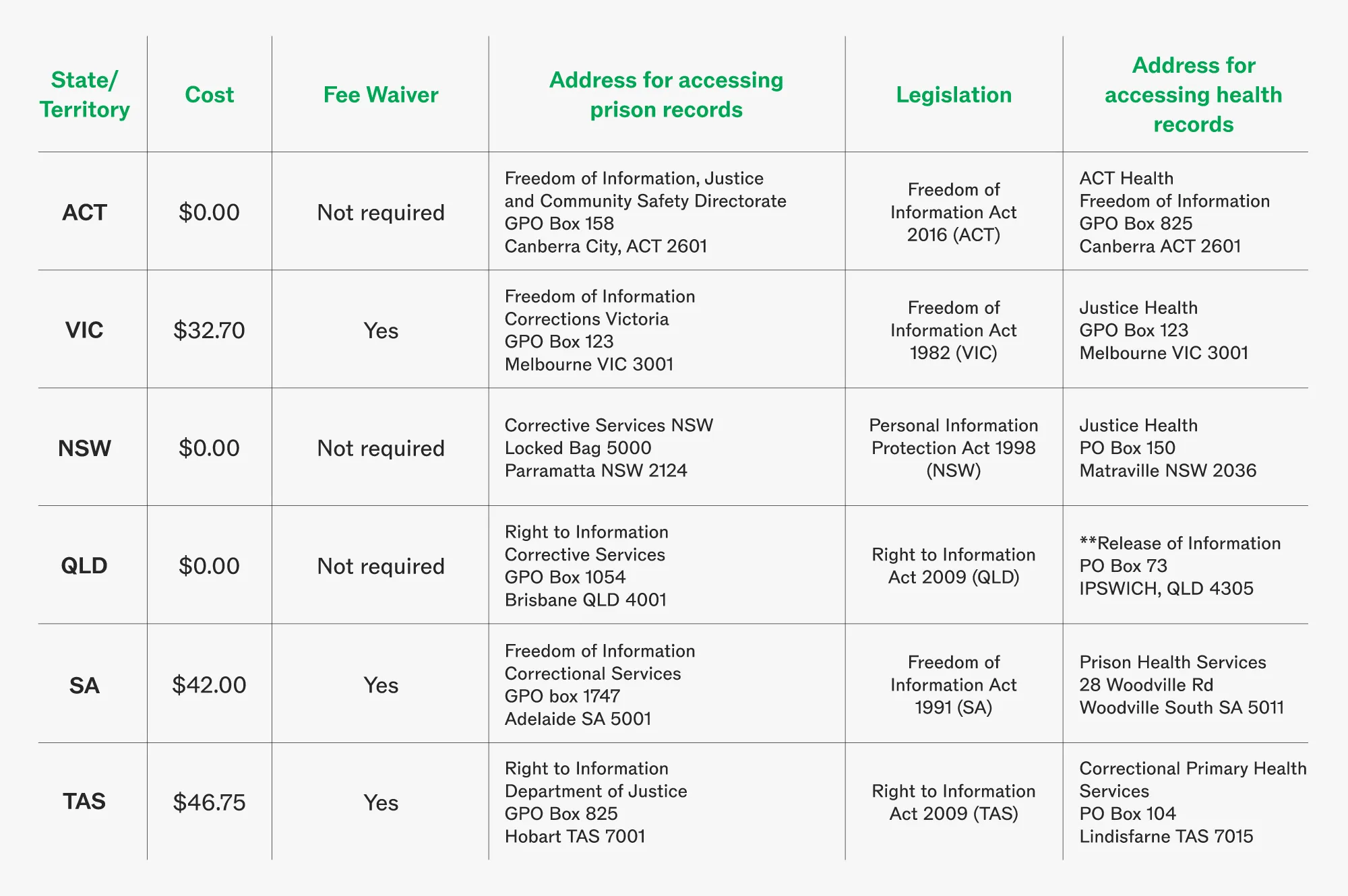

People who live in New South Wales, Queensland or the Australian Capital Territory can access their personal records without any fees. Victoria, Tasmania and South Australia all charge a fee (as per the table below). These fees can be waived for financial hardship. Most jurisdictions usually consider people in prison as facing financial hardship. Simply state in your application that you are applying for a fee waiver due to financial hardship due to imprisonment and provide your CRN (or prison number). You will be notified whether the fee waiver is granted.
South Australia, however, requires more information to prove financial hardship. A person incarcerated in South Australia must prove that they are not receiving enough money to cover their total weekly expenses. This is often easy to prove, and may require a simple written explanation of your daily prison expenses together with a print off of your prison account. Your explanation can include why you need to spend on supplementary canteen food, such as health food to ensure a balanced diet or sweets to minimise the mental health impacts of the prison environment.
Obtaining personal information is not just limited to information held by prison authorities. People can also obtain their medical records from prison health services. Applications for health records must, however, be made to the health agency rather than the prison authorities. Find the relevant addresses in the table above.
Stay tuned for part-two in the next edition of About Time, where we explain the review processes- what to do if you are unhappy with the response to your application.
If you find that any information here is incorrect, please let us know.
People who live in New South Wales, Queensland or the Australian Capital Territory can access their personal records without any fees. Victoria, Tasmania and South Australia all charge a fee (as per the table below). These fees can be waived for financial hardship. Most jurisdictions usually consider people in prison as facing financial hardship. Simply state in your application that you are applying for a fee waiver due to financial hardship due to imprisonment and provide your CRN (or prison number). You will be notified whether the fee waiver is granted.
South Australia, however, requires more information to prove financial hardship. A person incarcerated in South Australia must prove that they are not receiving enough money to cover their total weekly expenses. This is often easy to prove, and may require a simple written explanation of your daily prison expenses together with a print off of your prison account. Your explanation can include why you need to spend on supplementary canteen food, such as health food to ensure a balanced diet or sweets to minimise the mental health impacts of the prison environment.
Obtaining personal information is not just limited to information held by prison authorities. People can also obtain their medical records from prison health services. Applications for health records must, however, be made to the health agency rather than the prison authorities. Find the relevant addresses in the table above.
Stay tuned for part-two in the next edition of About Time, where we explain the review processes- what to do if you are unhappy with the response to your application.
If you find that any information here is incorrect, please let us know.
Strip searching is a security practice purportedly used by prison authorities to prevent drugs and other contraband from entering prisons.
There are major differences between how offences in prisons are dealt with around Australia. These offences typically range from minor ones, such as keeping an untidy cell, to more serious ones and others that can become criminal charges.
Bail is a promise you can make that you will return to court. It means you can stay in the community (instead of jail) until your legal matters finish. If you are being held in custody and you haven’t been found guilty, you may be able to apply for bail.
What is the legal sentence period after which an inmate must reapply for the DSP?
The law, like other professions, has its own language. It helps keep all the lawyers huddled around some special stuff and keep the rest of us outside.
On 1 April 2026, the Australian Parliament passed new laws which will change the way Commonwealth parole works.
People in prison can apply to transfer from a prison in one state or territory to another, generally for welfare reasons to be closer to family, community supports, or rehabilitation opportunities.
Inspectors and ombudsmen regularly go to prisons and publish reports on what they find and what they think needs to be improved. They also complete reports on issues such as access to healthcare or the use of segregation.