What to Do: Mandatory Visa Cancellation Letters

Ethan Cassidy


Your browser window currently does not have enough height, or is zoomed in too far to view our website content correctly. Once the window reaches the minimum required height or zoom percentage, the content will display automatically.
Alternatively, you can learn more via the links below.
The letter usually looks like this:
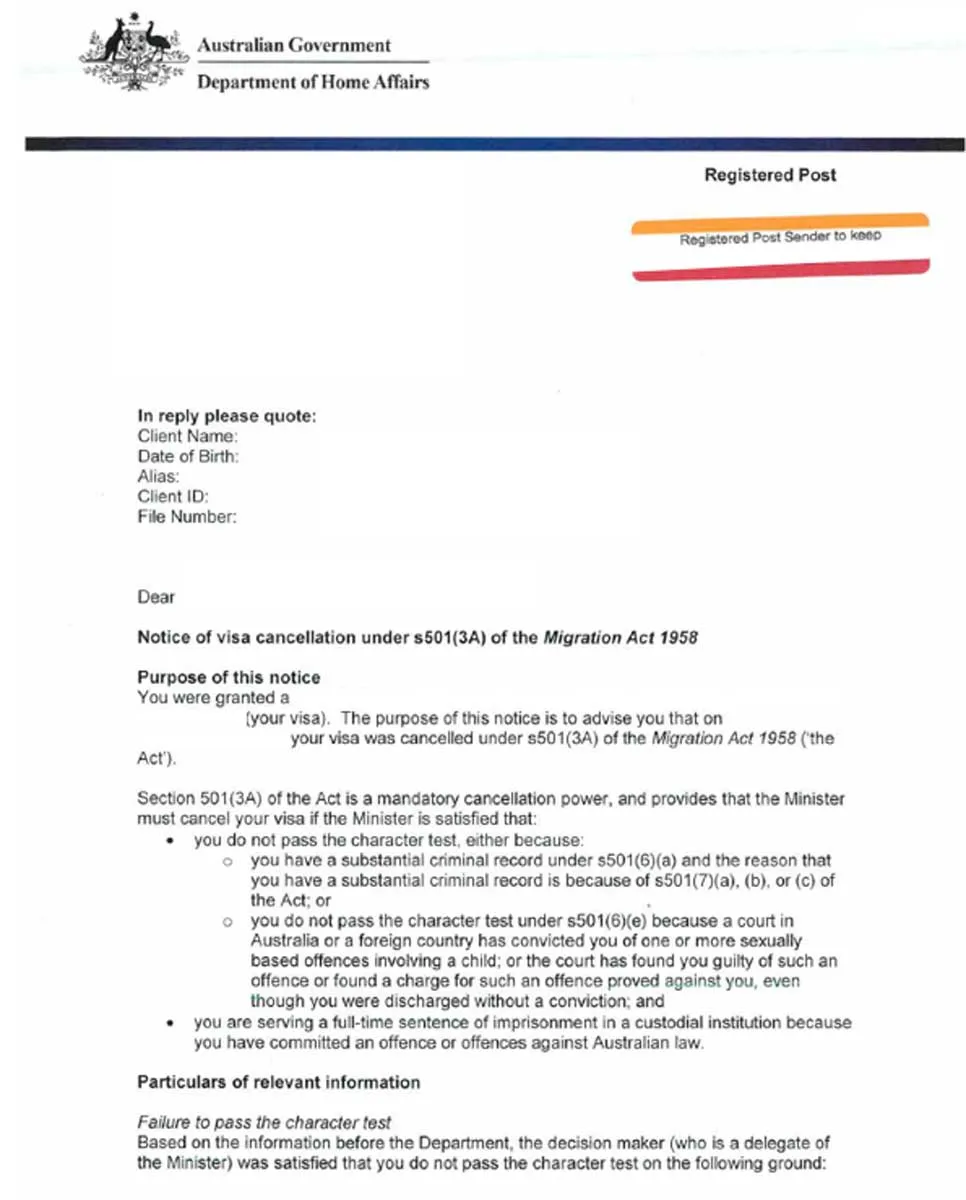
You got this letter to say that your visa has been cancelled due to your offending. This means you no longer hold a visa.
If you received a letter from the Department of Home Affairs about the cancellation of your visa, you should have also received a Revocation Request Form and a Personal Details Form.
If you want to ask the department to revoke the cancellation of your visa, you should complete and lodge these two forms within 28 days of receiving your visa cancellation notice.
You can lodge it by emailing it to the email address on the letter with the “in reply please quote” details.
It is very important that you lodge these forms within the 28-day time limit as no extensions can be granted. Immigration deadlines are very strict.
In addition to the Revocation Request Form and the Personal Details Form, you can write a short letter to the department with information that you want them to consider when they make a decision about whether they should revoke your visa cancellation.
After these have been submitted within 28 days, you can continue submitting supporting documents until a decision has been made. A list of documents we suggest you get is in this factsheet.
The department may consider the following things in making their decision:
If you get a negative decision, you will likely only have nine days to appeal. We ask that you then get legal help immediately.
Set out below is a list of documents it would be good to obtain in support of a character test submission.
These documents should be submitted in addition to completing the Revocation Request Form and submitting it within 28 days.
Don’t wait to have all these documents before submitting your revocation request. You can submit them afterwards.
RACS is entirely independent of the Department of Home Affairs. All assistance is free. RACS can provide refugees with legal advice on visa cancellation matters, but we rarely can represent them at the AAT. If your matter is at the AAT on a visa cancellation, or if you have no fears of persecution in your home country, we suggest at first instance you contact Legal Aid NSW’s immigration team to see if they can assist you: (02) 9219 5790.
1300 654 314
(03) 9413 0100
(Wednesday & Friday 10am–2pm)
1300 366 424
(03) 6169 9473
(07) 3846 9300
1800 019 343
1300 650 579
When people are imprisoned, they lose their freedom, but they do not lose all of their human rights. International human rights law makes this very clear.
Australia has two sources of law: legislation and common law. Legislation is made by parliaments and is available in documents called acts. Common law is made by judges in court decisions and covers areas that have not been legislated.
In recent years, regressive reform of parole laws in many places has made it increasingly difficult for people in prison to access parole.
If a prisoner is detained in solitary confinement, the conditions they face in custody are significantly more challenging compared to the general prison population. In some cases, this may be taken into account by a sentencing court and result in a shorter sentence being imposed.
The law, like other professions, has its own language. It helps keep all the lawyers huddled around some special stuff and keep the rest of us outside.
On 1 April 2026, the Australian Parliament passed new laws which will change the way Commonwealth parole works.
People in prison can apply to transfer from a prison in one state or territory to another, generally for welfare reasons to be closer to family, community supports, or rehabilitation opportunities.
Inspectors and ombudsmen regularly go to prisons and publish reports on what they find and what they think needs to be improved. They also complete reports on issues such as access to healthcare or the use of segregation.