Finding a Place to Live After Prison
What you need to know before release
Willy Pleasance


Your browser window currently does not have enough height, or is zoomed in too far to view our website content correctly. Once the window reaches the minimum required height or zoom percentage, the content will display automatically.
Alternatively, you can learn more via the links below.
Australia is in the middle of a housing crisis. This is making it harder for everyone to find affordable accommodation, but, for people leaving prison, the barriers can be even higher. While it can feel impossible and out of your control, there are some things you can do.
To give yourself the best chance, begin organising this as soon as you can. Plan ahead, search around, and talk to as many people as you can.
Before you try to organise housing, it can be useful to think carefully about the different types of housing that are available to people who are exiting prison. To help you, this article will go into some more detail about the most common housing options:
Keep in mind, your first choice may not work out. So always have a back-up plan.
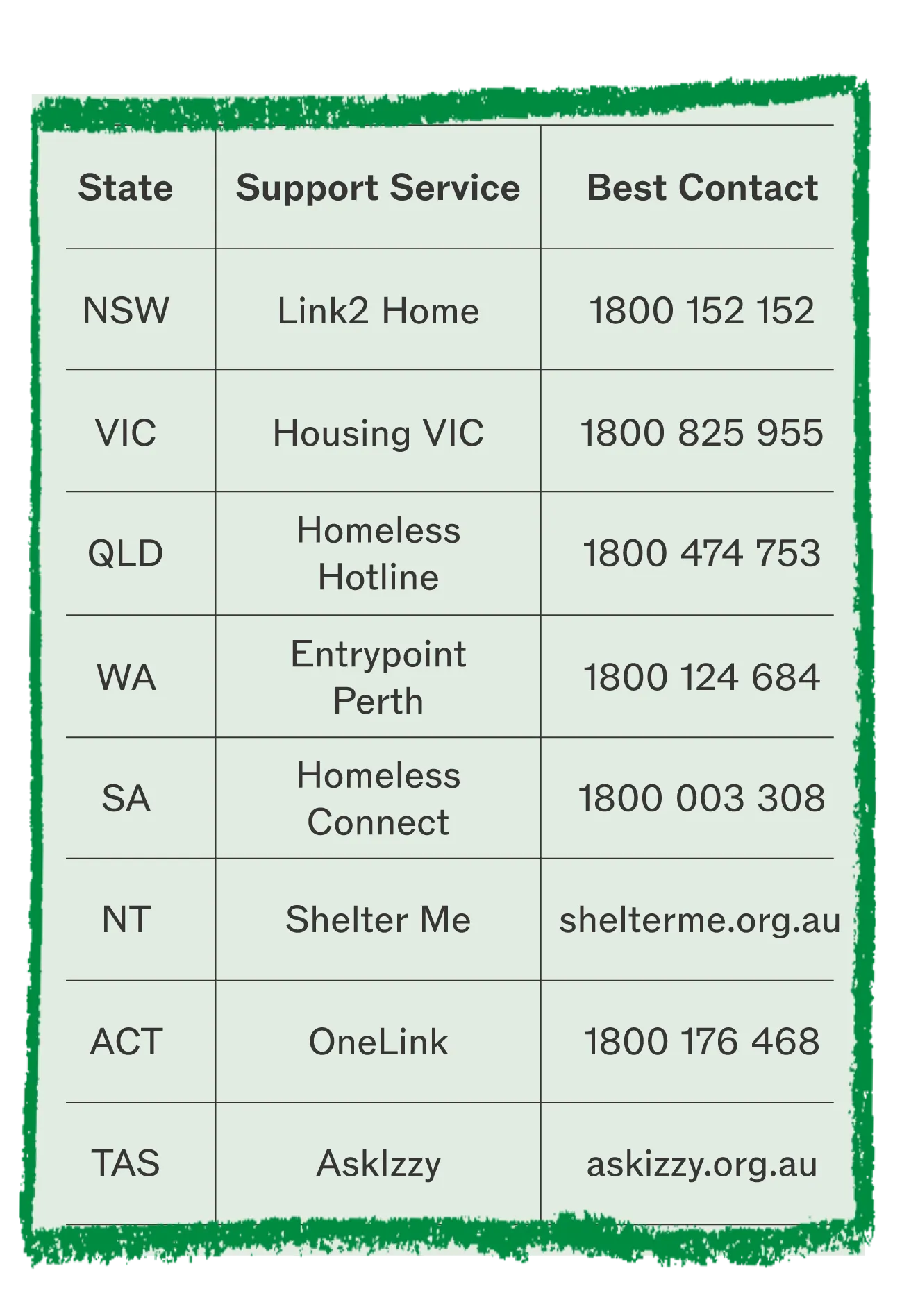
Crisis housing is also called emergency housing or homelessness services. It is only a short-term option. Different services run these housing options, so, depending on where you are, it is a good idea to ask about what is available to you if you find yourself without housing.
Each state and territory has its own hotline. They can tell you about any vacancies and link you with services that can help you.
Boarding houses, also called rooming houses, are often the only option available for some people, for various reasons, including not having family support or not being able to live in a certain area where family and friends are.
The best way to find a boarding house near you is by looking at local council websites or contacting housing agencies. Boarding houses are also sometimes listed through online directories like flatmates.com.au, RoomingKos, or realestate.com.au.
It is important to know the standards of boarding houses are often quite low, and they can be expensive for what you are getting. In most boarding houses, all facilities are shared, including kitchens, bathrooms and living spaces.
While they are not the cleanest places, it is important to keep your space clean and damage free to ensure you get your bond loan back.
While it is extremely difficult to organise a rental property from inside, it can be useful to start thinking about what you need to do to secure a rental property before then. Securing a rental takes time and planning, so, if this is a long-term goal of yours, it may make it easier if you begin working out what steps you will need to take.
There is a lack of rental properties across Australia right now. This means that there can often be a lot of competition for people trying to secure a rental. Don’t be discouraged by this. But be aware that, if you are going to apply for a rental, you need to be well prepared.
You should have:
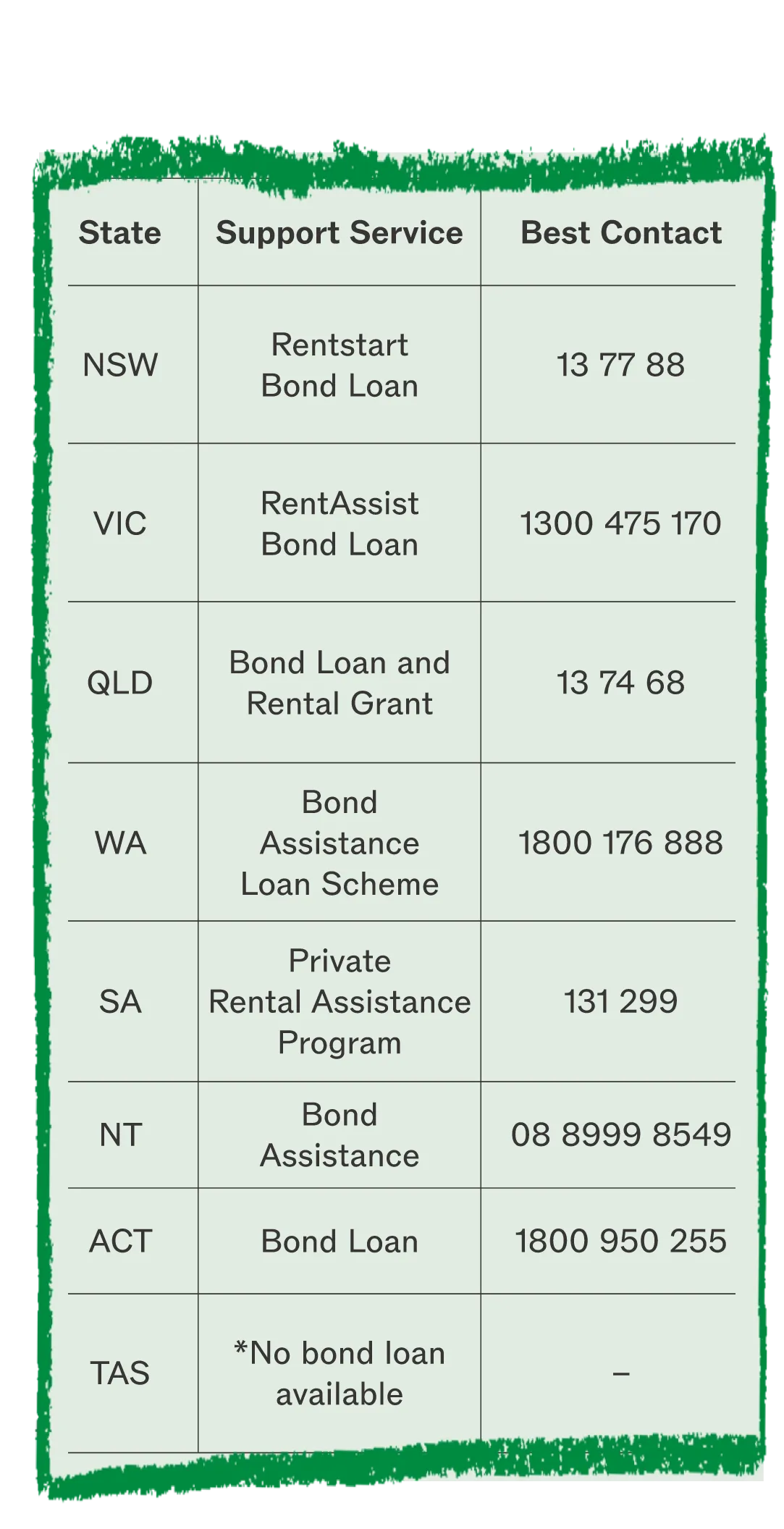
All states and territories offer bond loans or other forms of assistance to help cover the cost of a rental bond when you move into a new rental home. The loan amount for a bond loan is up to four weeks’ rent and must be repaid. No interest or fees apply.
Bond loan rules are different in each state. For example, in Tasmania, there is a system called Private Rental Assistance (PRA) that can provide one-off financial assistance to eligible people on low incomes to help pay bond and other expenses. An application can be made through Housing Connect. Each has slightly different eligibility requirements and procedures for access, so it is worth looking these up on the state government website that is relevant to you to find out more.
Here is a list of the different bond loan schemes for each state and territory:
Like rentals, sharehouses cannot be organised from prison. But, if sharehouses sound like an option that could work for you, it may make it easier if you begin working out what steps you will need to take now, before you are released.
Some people rent out one or two rooms in their house and advertise them online. This may be a more affordable option if you are unable to afford and enter the private rental market on your own.
Rooms in sharehouses are often advertised on websites like Gumtree, Facebook Marketplace and flatmates.com.au.
Keep in mind that, if you have a residential condition on your parole order, parole will need to call all other tenants in the house to confirm they are aware that you are on parole, your offences and any special conditions.
Where you live is also part of your parole. You might have conditions about where you can live and who you can live with. Ask Sentence Management in your centre what some of these might be.
Keep in mind that, if you have a residential condition on your parole order, Community Corrections or Corrective Services will need to speak to anyone you live with.
Because you will be sharing sensitive information with people you may not know well, it may be a good idea to find out from Community Corrections or Corrective Services what your housemates need to know so that you are sharing enough information but not too much.
The most common things they will need to know are:
Every state has long-term housing for people on low incomes. Rent is about 30 per cent of your income, but the wait can be several years long.
You can apply for public housing while you are still in custody. We strongly support this as your application will be backdated to when you first submitted it. When you are in prison, your application will be put on hold, and you need to activate it within 28 days of being released. Your time in custody will then be counted as time on the waitlist.
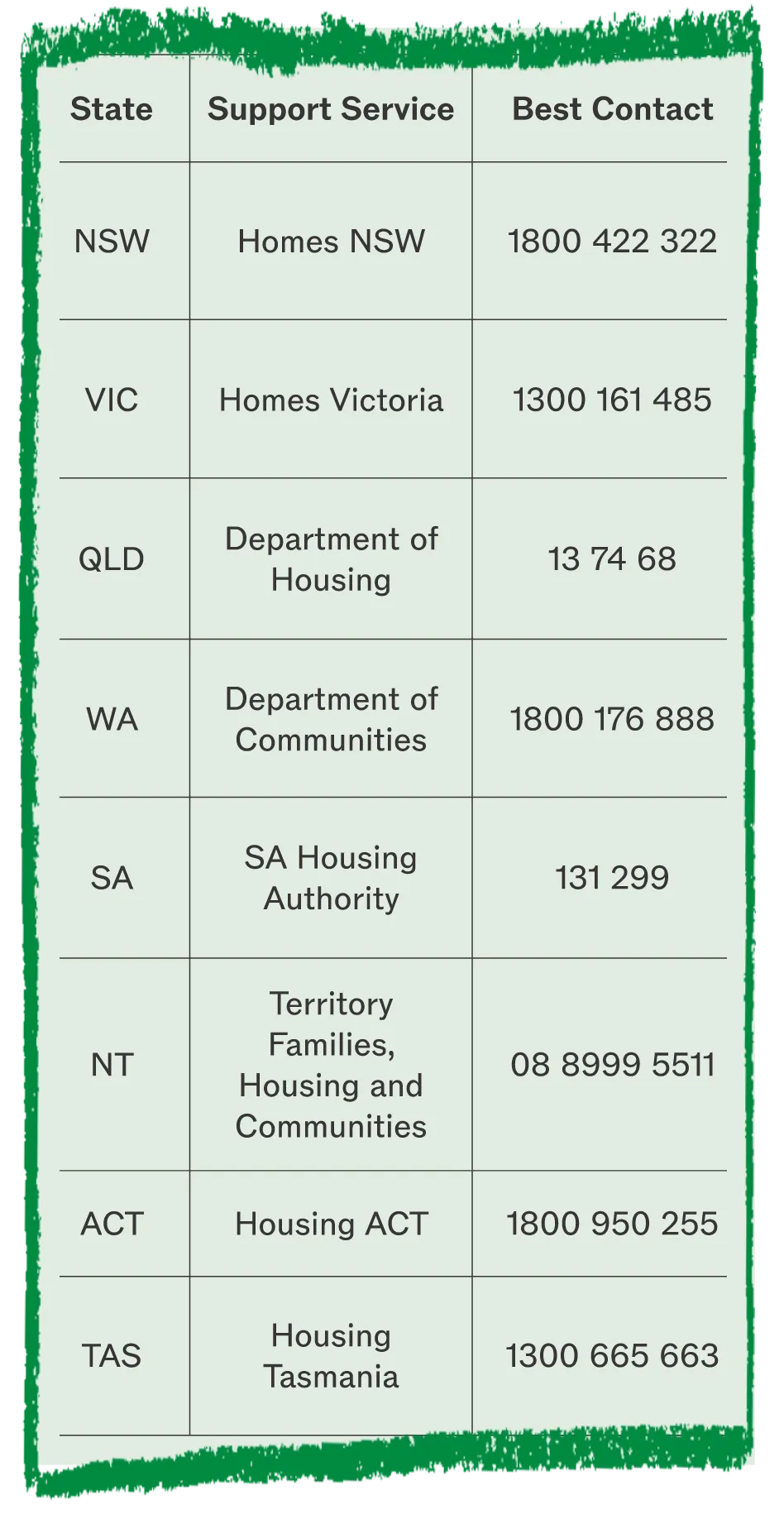
When you attend housing after your release, you can tailor your application and speak to the relevant government department in your state about further support. The government department you should speak to has a different name depending on the state or territory you live in:
Ask your unit officer for a relevant housing application form.
Those who plan early, explore all their options and prepare both a ‘Plan A’ and a ‘Plan B’ have a better chance of finding stable housing and making it work for them long term.
Feeling isolated and lonely is very common after you’ve left prison. In prison you didn’t expect to open up to people and enjoy their company. Now you’re outside, it takes time to relax and be friendly to people.
You had questions, we listened! These answers are from my life (and are supposed to make you smile a bit!).
Everyone has the right to dream. To expect. To imagine a version of life where we get to decide who we are – not just live with who we’ve been told we are. That kind of dreaming is powerful. It keeps something alive in us. Something worth fighting for.
This is a very special Ask Stacey, as I finished parole! And the questions came from all sorts of different people in the justice system.
Owning my story became one of the most liberating decisions I’ve ever made.
Not once did somebody ask me what I needed, what mattered to me, or what healing looked like from my perspective.
Welcome to another exciting instalment of Ask Stacey! And I got one of my favourite questions!
For any person in prison and coming up for release within the next year, have you ever thought about what your transitional worker should be doing?