
Visitors to the decommissioned Fremantle Prison, now a major tourist attraction in Western Australia on Whadjuk Noongar Country, enter through a forecourt in front of the bleak Main Cell Block.
If they turned right and looked toward the south end of the site, beyond the lawn and paved pathways, they would spy the remains of a 100-year-old terraced vegetable garden.
Perched on a hill beneath a towering perimeter wall are retaining beds built in 1896, still filled with dirt, roots and a few plants hell-bent on growing. Rosemary bushes leer over the side, stumps with young green shoots reach upwards and a series of wire frames – that perhaps supported tomato vines or pole beans – are still hanging in the wind.
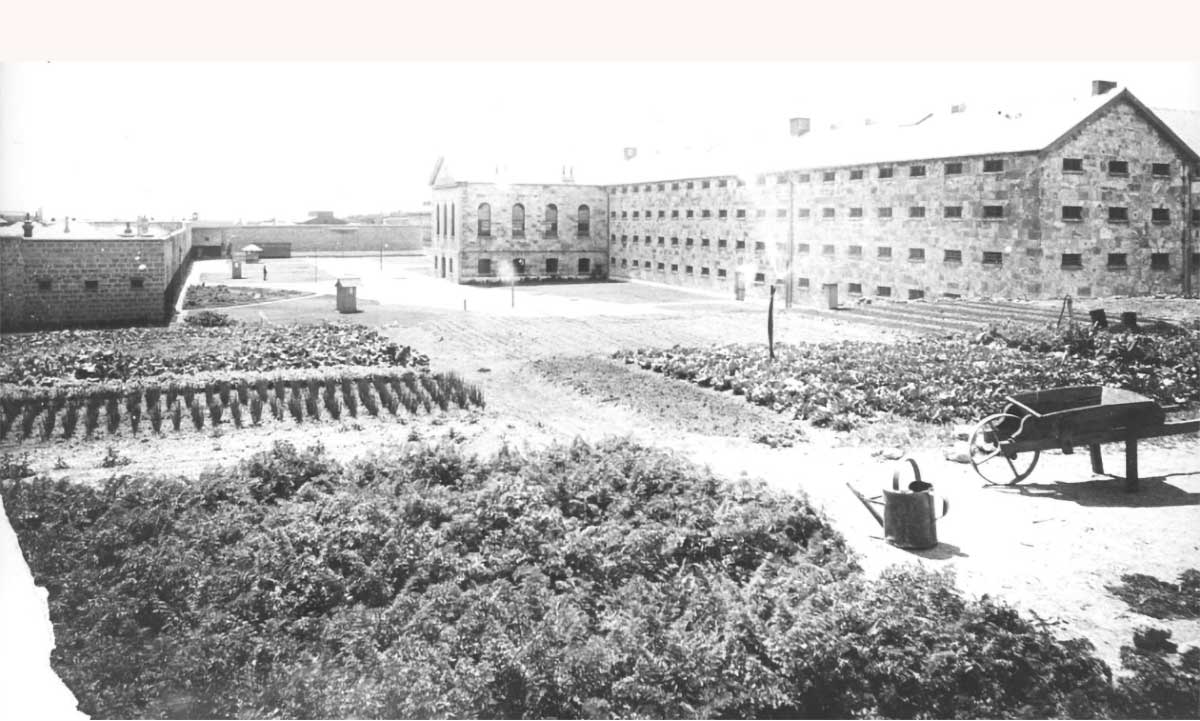
Built by convict labour during the 1850s, Fremantle Prison operated for 136 years until it closed in 1991. Their once-thriving vegetable garden took shape after a 1911 reform that allowed people in prison to earn shorter sentences through good behaviour. Fremantle Prison introduced new activities focused on welfare and rehabilitation, including a leisure program, access to education and the establishment of a veggie patch.
The men at Fremantle Prison learnt how to grow fresh food by planting concentrated rows of sturdy cabbage, corn, carrots, spring onions and other edible plants that could withstand the harsh WA sun. At its peak, the garden supplied the prison kitchen with more than 10,000 kilograms of fruit and vegetables each year.
A 1913 prison report noted: “The immense courtyard before the cells, once a sickening expanse of glaringly white limestone, is now covered with neatly kept lawns bordered in places with flowers, and on the terraced banks to the right as one enters are vegetable gardens, at once refreshingly green to the eye and utilitarian in their purpose.”
Records from the 1920s show the gardens “were a highly successful innovation” that provided meaningful tasks and recreation for the prison population. There was a pause in gardening during the 1940s, most likely due to the war, but the gardens continued to thrive in the 1950s and 1960s.
During this era, creativity was permitted and the gardens were embellished with decorative brick edgings and an ornamental goldfish pond. Roses, chrysanthemums, gladioli, petunias and carnations were grown in flowerpots and entered in the Perth Royal Show.
A 1955 newspaper article interviewed a man serving a life sentence at Fremantle Prison who gained a new outlook on life after nurturing a colourful array of prize-winning flowers. He said: “I like the open air. I had been working in the prison tailoring shop, but I never seemed to see anything for my work. I had no sense of achievement.” Given the chance to work in the garden, he found contentment and pride in the blooms he grew.
Despite providing a rewarding and therapeutic outlet for over 60 years, by the late 1970s the vegetable garden had shrunk to make way for a clothes-drying area, lawns, a tennis court and a concrete cricket pitch. These new facilities were enclosed by a tall metal cyclone fence.
Although there are no records of how this vegetable garden improved the health and wellbeing of the men who grew fresh, healthy food, these days the evidence is well-documented. Research from 2024 shows prison gardening provides a wide range of benefits, from opportunities to de-stress and increase physical activity to improved self-esteem and the development of skills that support employability, reintegration and healthier living.
Growing food reflects family and cultural traditions, which can improve social understanding and relationships between people in prison and prison staff. Plus, linking garden-grown food to the kitchen improves the nutritional quality and flavour of prison meals.
Prison gardens are low-cost, activate barren spaces and increase access to nature. Gardening provides a sense of purpose and even a chance to give back to the community, with some Australian prison gardening programs donating seeds and food to schools and homeless shelters.
Today, only traces of Fremantle Prison’s terraced beds remain, but it’s a quiet reminder that, even in the most controlled environments, growth is possible for prison grounds and the people who tend to them.
Records from the 1920s show the gardens “were a highly successful innovation” that provided meaningful tasks and recreation for the prison population. There was a pause in gardening during the 1940s, most likely due to the war, but the gardens continued to thrive in the 1950s and 1960s.
During this era, creativity was permitted and the gardens were embellished with decorative brick edgings and an ornamental goldfish pond. Roses, chrysanthemums, gladioli, petunias and carnations were grown in flowerpots and entered in the Perth Royal Show.
A 1955 newspaper article interviewed a man serving a life sentence at Fremantle Prison who gained a new outlook on life after nurturing a colourful array of prize-winning flowers. He said: “I like the open air. I had been working in the prison tailoring shop, but I never seemed to see anything for my work. I had no sense of achievement.” Given the chance to work in the garden, he found contentment and pride in the blooms he grew.
Despite providing a rewarding and therapeutic outlet for over 60 years, by the late 1970s the vegetable garden had shrunk to make way for a clothes-drying area, lawns, a tennis court and a concrete cricket pitch. These new facilities were enclosed by a tall metal cyclone fence.
Although there are no records of how this vegetable garden improved the health and wellbeing of the men who grew fresh, healthy food, these days the evidence is well-documented. Research from 2024 shows prison gardening provides a wide range of benefits, from opportunities to de-stress and increase physical activity to improved self-esteem and the development of skills that support employability, reintegration and healthier living.
Growing food reflects family and cultural traditions, which can improve social understanding and relationships between people in prison and prison staff. Plus, linking garden-grown food to the kitchen improves the nutritional quality and flavour of prison meals.
Prison gardens are low-cost, activate barren spaces and increase access to nature. Gardening provides a sense of purpose and even a chance to give back to the community, with some Australian prison gardening programs donating seeds and food to schools and homeless shelters.
Today, only traces of Fremantle Prison’s terraced beds remain, but it’s a quiet reminder that, even in the most controlled environments, growth is possible for prison grounds and the people who tend to them.


