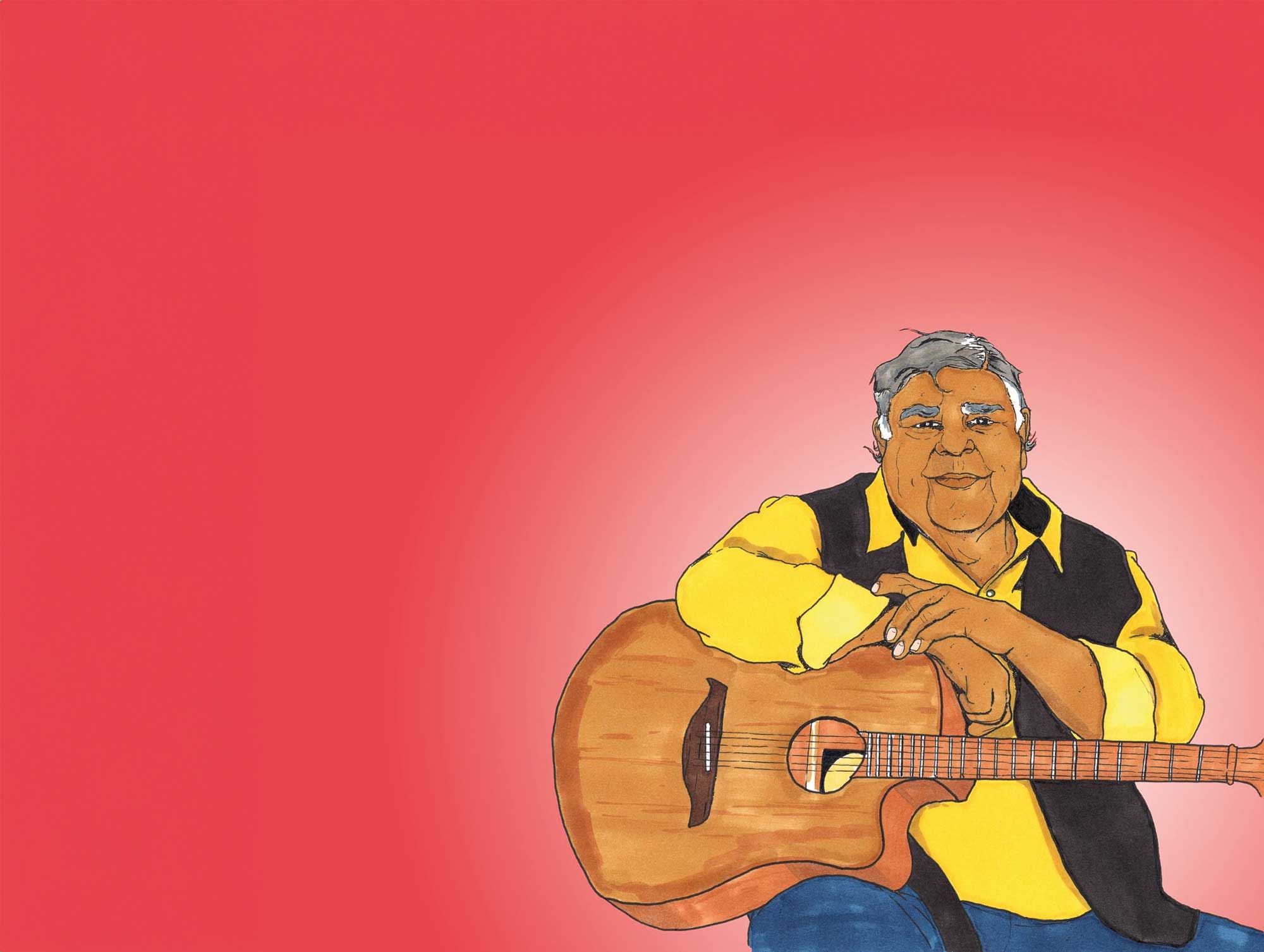
Beloved First Nations musician Roger Knox’s career has spanned more than 50 years and taken him from an Aboriginal Mission in NSW to some of the biggest stages in the world.
Thanks to his early hairstyle and clothes, and promotion of Australian Aboriginal culture and stories in his music, he was called the “Koori King of Country” and the “Black Elvis”.
Combining First Nations spirituality with country music, Uncle Roger has released five much-loved albums.
He was named NAIDOC Artist of the Year in 1993, in 2004 was inducted into the Australian Country Music Foundation’s Country Music Hands of Fame and received the Jimmy Little Award for Lifetime Achievement in Aboriginal and Torres Strait Music at the 2006 Deadlys.
He has been a passionate advocate for First Nations justice, land rights, culture and Black history, and regularly brings attention to these issues through his music.
Uncle Roger was born in 1948 at the Toomelah Aboriginal Mission in NSW. He is a proud member of the Gamilaroi nation, and his mother was a part of the Stolen Generation.
He regularly faced racism in his childhood; he was not allowed to attend the local high school in Goondiwindi, and instead was sent by the mission to work without pay at one of their properties.
He says music was a constant in his life from the very start – he discovered gospel music through his mother, and country and rock and roll bands through other family members. “Music was always a part of my upbringing,” Uncle Roger tells About Time.
When he was 17 years old, Uncle Roger moved to Tamworth and performed live music for the first time in the town’s local pub. “That was the first time I heard the applause of people – I was nervous but I did it, and I really enjoyed it,” he says.
It was also in Tamworth that Uncle Roger first played in a prison. He was invited to perform at the local jail, which at the time was a youth detention facility. “The young people really enjoyed the stories and the songs,” he says.
“It was hard at first. When you perform you can’t go in there half-hearted or mediocre. You have to go in there full on, give it everything you’ve got and put 100 per cent effort in there.”
His success in music has taken him around the world, including to play shows in Canadian prisons and to more than 37,000 people at the Hardly Strictly Bluegrass Festival in San Francisco, where he received a standing ovation.
Days before About Time spoke with Uncle Roger, he played at the Sydney Opera House with his family.
This was another major milestone for the legendary musician. But he says the shows that mean the most to him are the ones he has played in prisons around the country.
After that first performance in Tamworth prison, Uncle Roger has played countless shows to inmates in Australian prisons across several decades.
“I’ve performed at some of the highest venues, not only here but overseas, but to me when I think back, I think my highest points, the highlight of anything I’ve done, was going into these prisons and singing to people in there who might have thought they were lost or forgotten,” Uncle Roger says.
Each time he has played in a prison, Uncle Roger has taken an Aboriginal flag and asked inmates to sign it.
Beloved First Nations musician Roger Knox’s career has spanned more than 50 years and taken him from an Aboriginal Mission in NSW to some of the biggest stages in the world.
Thanks to his early hairstyle and clothes, and promotion of Australian Aboriginal culture and stories in his music, he was called the “Koori King of Country” and the “Black Elvis”.
Combining First Nations spirituality with country music, Uncle Roger has released five much-loved albums.
He was named NAIDOC Artist of the Year in 1993, in 2004 was inducted into the Australian Country Music Foundation’s Country Music Hands of Fame and received the Jimmy Little Award for Lifetime Achievement in Aboriginal and Torres Strait Music at the 2006 Deadlys.
He has been a passionate advocate for First Nations justice, land rights, culture and Black history, and regularly brings attention to these issues through his music.
Uncle Roger was born in 1948 at the Toomelah Aboriginal Mission in NSW. He is a proud member of the Gamilaroi nation, and his mother was a part of the Stolen Generation.
He regularly faced racism in his childhood; he was not allowed to attend the local high school in Goondiwindi, and instead was sent by the mission to work without pay at one of their properties.
He says music was a constant in his life from the very start – he discovered gospel music through his mother, and country and rock and roll bands through other family members. “Music was always a part of my upbringing,” Uncle Roger tells About Time.
When he was 17 years old, Uncle Roger moved to Tamworth and performed live music for the first time in the town’s local pub. “That was the first time I heard the applause of people – I was nervous but I did it, and I really enjoyed it,” he says.
It was also in Tamworth that Uncle Roger first played in a prison. He was invited to perform at the local jail, which at the time was a youth detention facility. “The young people really enjoyed the stories and the songs,” he says.
“It was hard at first. When you perform you can’t go in there half-hearted or mediocre. You have to go in there full on, give it everything you’ve got and put 100 per cent effort in there.”
His success in music has taken him around the world, including to play shows in Canadian prisons and to more than 37,000 people at the Hardly Strictly Bluegrass Festival in San Francisco, where he received a standing ovation.
Days before About Time spoke with Uncle Roger, he played at the Sydney Opera House with his family.
This was another major milestone for the legendary musician. But he says the shows that mean the most to him are the ones he has played in prisons around the country.
After that first performance in Tamworth prison, Uncle Roger has played countless shows to inmates in Australian prisons across several decades.
“I’ve performed at some of the highest venues, not only here but overseas, but to me when I think back, I think my highest points, the highlight of anything I’ve done, was going into these prisons and singing to people in there who might have thought they were lost or forgotten,” Uncle Roger says.
Each time he has played in a prison, Uncle Roger has taken an Aboriginal flag and asked inmates to sign it.
The prison visits and shows have also inspired many of Uncle Roger’s songs.
‘Prison Wall’ describes a man in prison being visited by his son:
“She brought the son I hardly know
He didn’t smile, he didn’t speak
Seemed like he couldn’t wait to go
I long to pick him up and tell him
I’ll always be there should he fall
Was he scared of me or scared to be
Behind the prison wall?”
The song ‘Warrior in Chains’ describes a man hearing someone in the cell next to him singing.
“I heard him crying late one night
As I was lying in the dark
He started singing out his song
He sang it from the heart.”
‘Murri’s Plea’ is about a young First Nations man he met who didn’t want to tell his parents that he was in prison.
“A broken hearted Murri sits alone
In his eyes there was a picture of his mum and dear old dad
And a sweetheart he’d left away back home
Don’t tell my mum and dad
I know it will make them feel sad
Don’t tell them I am doing time
It’ll break their hearts and mind
Don’t tell my mum and dad I’m doing time.”
Uncle Roger now runs into people in the community who he played for in prison decades ago.
“You get to meet them and their families – to me that means a lot,” he says.
NAIDOC Week, which takes place from 5-12 July this year with a theme of “50 Years of Deadly”, recognises and celebrates the history, culture and achievements of First Nations Australians.
For mob currently on the inside, Uncle Roger urges them to focus on themselves and personal responsibility. “Be yourself – be strong within yourself,” he says.
“Self is the big word: self-knowledge, self-pride, self-respect, self-love, self-esteem. Be responsible to yourselves and to your families and to your communities.
“We need to come together in strength, unity, harmony and peace. Believe in yourself and be strong.”
For those approaching their release date, Roger said it’s important to remember the main things in life. “Enjoy your freedom – pick a different path and follow that path,” he says.
“We need more of our strong people out here to be with family, because family is everything, family is healing. Once you walk out of them gates, you’ve done your crime and done the time, stay out.”
“If you know where you come from, you know where you’re going to go. Focus on that and set a course to the future.”
The prison visits and shows have also inspired many of Uncle Roger’s songs.
‘Prison Wall’ describes a man in prison being visited by his son:
“She brought the son I hardly know
He didn’t smile, he didn’t speak
Seemed like he couldn’t wait to go
I long to pick him up and tell him
I’ll always be there should he fall
Was he scared of me or scared to be
Behind the prison wall?”
The song ‘Warrior in Chains’ describes a man hearing someone in the cell next to him singing.
“I heard him crying late one night
As I was lying in the dark
He started singing out his song
He sang it from the heart.”
‘Murri’s Plea’ is about a young First Nations man he met who didn’t want to tell his parents that he was in prison.
“A broken hearted Murri sits alone
In his eyes there was a picture of his mum and dear old dad
And a sweetheart he’d left away back home
Don’t tell my mum and dad
I know it will make them feel sad
Don’t tell them I am doing time
It’ll break their hearts and mind
Don’t tell my mum and dad I’m doing time.”
Uncle Roger now runs into people in the community who he played for in prison decades ago.
“You get to meet them and their families – to me that means a lot,” he says.
NAIDOC Week, which takes place from 5-12 July this year with a theme of “50 Years of Deadly”, recognises and celebrates the history, culture and achievements of First Nations Australians.
For mob currently on the inside, Uncle Roger urges them to focus on themselves and personal responsibility. “Be yourself – be strong within yourself,” he says.
“Self is the big word: self-knowledge, self-pride, self-respect, self-love, self-esteem. Be responsible to yourselves and to your families and to your communities.
“We need to come together in strength, unity, harmony and peace. Believe in yourself and be strong.”
For those approaching their release date, Roger said it’s important to remember the main things in life. “Enjoy your freedom – pick a different path and follow that path,” he says.
“We need more of our strong people out here to be with family, because family is everything, family is healing. Once you walk out of them gates, you’ve done your crime and done the time, stay out.”
“If you know where you come from, you know where you’re going to go. Focus on that and set a course to the future.”