Australia's National
Prison Newspaper

Australia's National
Prison Newspaper

Welcome to About Time

About Time is the national newspaper for Australian prisons and detention facilities

Your browser window currently does not have enough height, or is zoomed in too far to view our website content correctly. Once the window reaches the minimum required height or zoom percentage, the content will display automatically.

Alternatively, you can learn more via the links below.

Donations via GiveNow

Email

Instagram

LinkedIn

ISSUE NO. 19

February 2026

Donate Here

Health

Ask the Doctor: Stroke
Harley Stiebel is a Resident Medical Officer at The Royal Children’s Hospital and Founder of Scrublets.

Font Size
Font Size
Line Height
Line Height
Dyslexia Friendly
Black & White
Hide Images
Night Mode

Hello! I’m Harley, a doctor working in Victoria. Welcome back to Ask the Doctor!

Today, we are talking about stroke.

What is a stroke?

A stroke describes death to brain tissue caused by disrupted blood supply.

There are two main types of strokes:

1. Blood vessel blockage (ischaemic stroke) – most common

An ischaemic stroke is a blockage of an artery in your brain. It’s basically the brain’s version of a heart attack. These blockages are usually caused by bits of fat or blood clots.

2. Burst blood vessel (haemorrhagic stroke)

A haemorrhagic stroke occurs when an artery bursts. In young people this can occur from a big whack to the head. In older people, arteries become more fragile over time, due to normal aging, high blood pressure, and other habits your doctor probably complains about.

If the blood supply to the brain is impaired, how quickly does the brain start to die?

Brain tissue is extremely hungry – it uses more energy than any other part of your body. Brain cells begin to die after five minutes without a fresh blood supply; they’d rather die than starve.

What does it look like when someone has a stroke?

This is a tricky question. The symptoms of a stroke will differ depending on the area of blood supply to the brain that is disrupted.

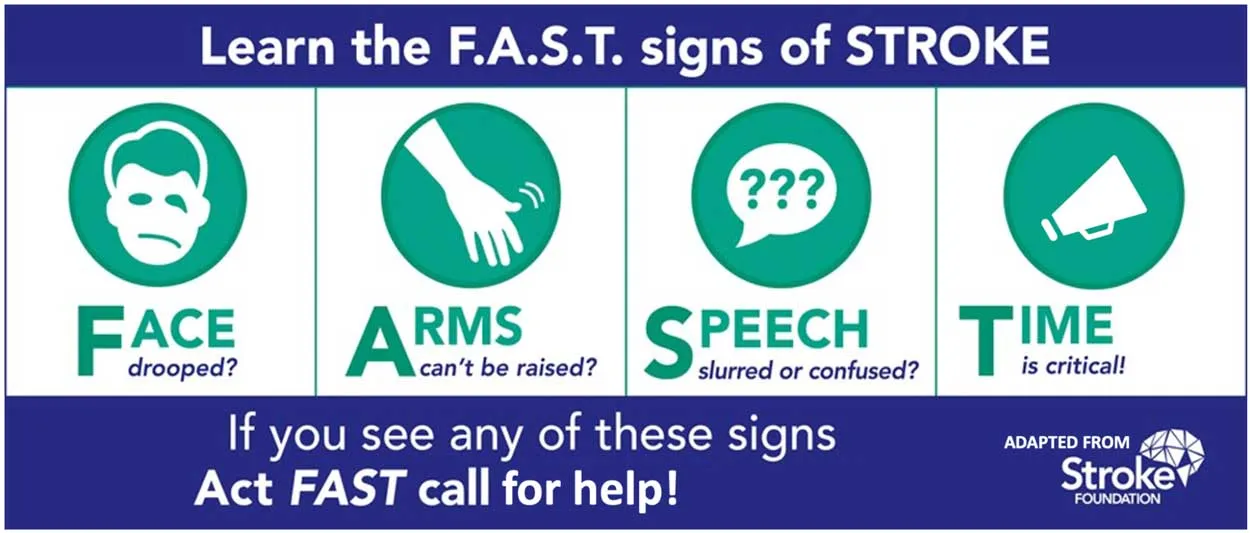
Things you might see are:

  • A drooping appearance of the face on one side
  • Slurred speech, like they are drunk
  • Weakness of the arm and leg on the same side of the body
  • Confusion

So what is a mini-stroke?

You might have heard people use the term “mini-stroke” – the medical term for this is Transient Ischaemic Attack (TIA).

Put simply, a mini-stroke occurs when the disrupted blood supply to the brain is brief. The brain is starved of oxygen long enough for the symptoms to appear, but not long enough for the brain tissue to die. Therefore, the person will not have any lasting symptoms (such as weakness of their arm).

However, it’s important to recognise that a mini-stroke is a BIG warning sign. If someone has had a mini-stroke they are much more likely to have a not-so-mini stroke in the future.

How do I prevent myself from having a stroke?

  1. Treating high blood pressure and high cholesterol
  2. 150mins of moderate exercise
    a week
  3. Being in a healthy body weight
  4. Not smoking cigarettes

If you think you might need to make changes to improve your health, please speak to your doctor, they’ll be able to give you personalised advice.

Thanks for reading this month’s article!

Please write to About Time with any questions you have or suggestions for future topics. Trust me, nothing is off limits – most of my day is spent asking whether people have opened their bowels or farted.

Hello! I’m Harley, a doctor working in Victoria. Welcome back to Ask the Doctor!

Today, we are talking about stroke.

What is a stroke?

A stroke describes death to brain tissue caused by disrupted blood supply.

There are two main types of strokes:

1. Blood vessel blockage (ischaemic stroke) – most common

An ischaemic stroke is a blockage of an artery in your brain. It’s basically the brain’s version of a heart attack. These blockages are usually caused by bits of fat or blood clots.

2. Burst blood vessel (haemorrhagic stroke)

A haemorrhagic stroke occurs when an artery bursts. In young people this can occur from a big whack to the head. In older people, arteries become more fragile over time, due to normal aging, high blood pressure, and other habits your doctor probably complains about.

If the blood supply to the brain is impaired, how quickly does the brain start to die?

Brain tissue is extremely hungry – it uses more energy than any other part of your body. Brain cells begin to die after five minutes without a fresh blood supply; they’d rather die than starve.

What does it look like when someone has a stroke?

This is a tricky question. The symptoms of a stroke will differ depending on the area of blood supply to the brain that is disrupted.

Things you might see are:

  • A drooping appearance of the face on one side
  • Slurred speech, like they are drunk
  • Weakness of the arm and leg on the same side of the body
  • Confusion

So what is a mini-stroke?

You might have heard people use the term “mini-stroke” – the medical term for this is Transient Ischaemic Attack (TIA).

Put simply, a mini-stroke occurs when the disrupted blood supply to the brain is brief. The brain is starved of oxygen long enough for the symptoms to appear, but not long enough for the brain tissue to die. Therefore, the person will not have any lasting symptoms (such as weakness of their arm).

However, it’s important to recognise that a mini-stroke is a BIG warning sign. If someone has had a mini-stroke they are much more likely to have a not-so-mini stroke in the future.

How do I prevent myself from having a stroke?

  1. Treating high blood pressure and high cholesterol
  2. 150mins of moderate exercise
    a week
  3. Being in a healthy body weight
  4. Not smoking cigarettes

If you think you might need to make changes to improve your health, please speak to your doctor, they’ll be able to give you personalised advice.

Thanks for reading this month’s article!

Please write to About Time with any questions you have or suggestions for future topics. Trust me, nothing is off limits – most of my day is spent asking whether people have opened their bowels or farted.

Leave a Comment

Thank you! Your submission has been received!
Oops! Something went wrong while submitting the form.
0 Comments
Author Name
Comment Time

Lorem ipsum dolor sit amet, consectetur adipiscing elit. Suspendisse varius enim in eros elementum tristique. Duis cursus, mi quis viverra ornare, eros dolor interdum nulla, ut commodo diam libero vitae erat. Aenean faucibus nibh et justo cursus id rutrum lorem imperdiet. Nunc ut sem vitae risus tristique posuere. uis cursus, mi quis viverra ornare, eros dolor interdum nulla, ut commodo diam libero vitae erat. Aenean faucibus nibh et justo cursus id rutrum lorem imperdiet. Nunc ut sem vitae risus tristique posuere.

Yoga for Good Digestion

Reprinted with permission from Inside Time

Determined to make positive changes in life? It can start with digestion!

Health

ISSUE NO. 19

2 MIN READ

Three of My Friends Are Alive Because I Had Naloxone

By Marianna Jans

I am lucky to have not lost anyone close to me from a drug overdose, but I know many people who have. The impact that a fatal overdose can cause is devastating and they are completely avoidable and unnecessary.

Health

ISSUE NO. 19

3 MIN READ

Want to Get Fit for 2026?

Exercises reprinted with permission from Inside Time

Whether you want to get in gear to transform your physique, or maybe just tone up, there is a selection of exercises you can do without any equipment, in your cell or in the exercise yard.

Health

ISSUE NO. 18

2 MIN READ

Mind on Loop: Dealing With Rumination

By Stephen Rothwell

I kept replaying the trauma, desperately hoping for a different ending, driven by an intensity of pain I could not bear.

Health

ISSUE NO. 18

3 MIN READ

Newsletter

Be the first to learn about our monthly stories, plus new initiatives and live events

You've successfully registered!
Something went wrong when we tried to register your details. Please try again.

Support Australia's First National Prison Newspaper

A place for news and education, expression and hope

Help keep the momentum going. All donations will be vital in providing an essential resource for people in prison and their loved ones.

All donations of $2 or more are tax deductible. If you would like to pay directly into our bank account to avoid the processing fee, please contact donate@abouttime.org.au. ABN 67 667 331 106.

It's
About Time.

A place for news and education, expression and hope.

Help us get About Time off the ground. All donations are tax deductible and will be vital in providing an essential resource for people in prison and their loved ones.

Donate Here

Newsletter

Be the first to learn about our monthly stories, plus new initiatives and live events

You've successfully registered!
Something went wrong when we tried to register your details. Please try again.