


Donate Here
•
Experiences
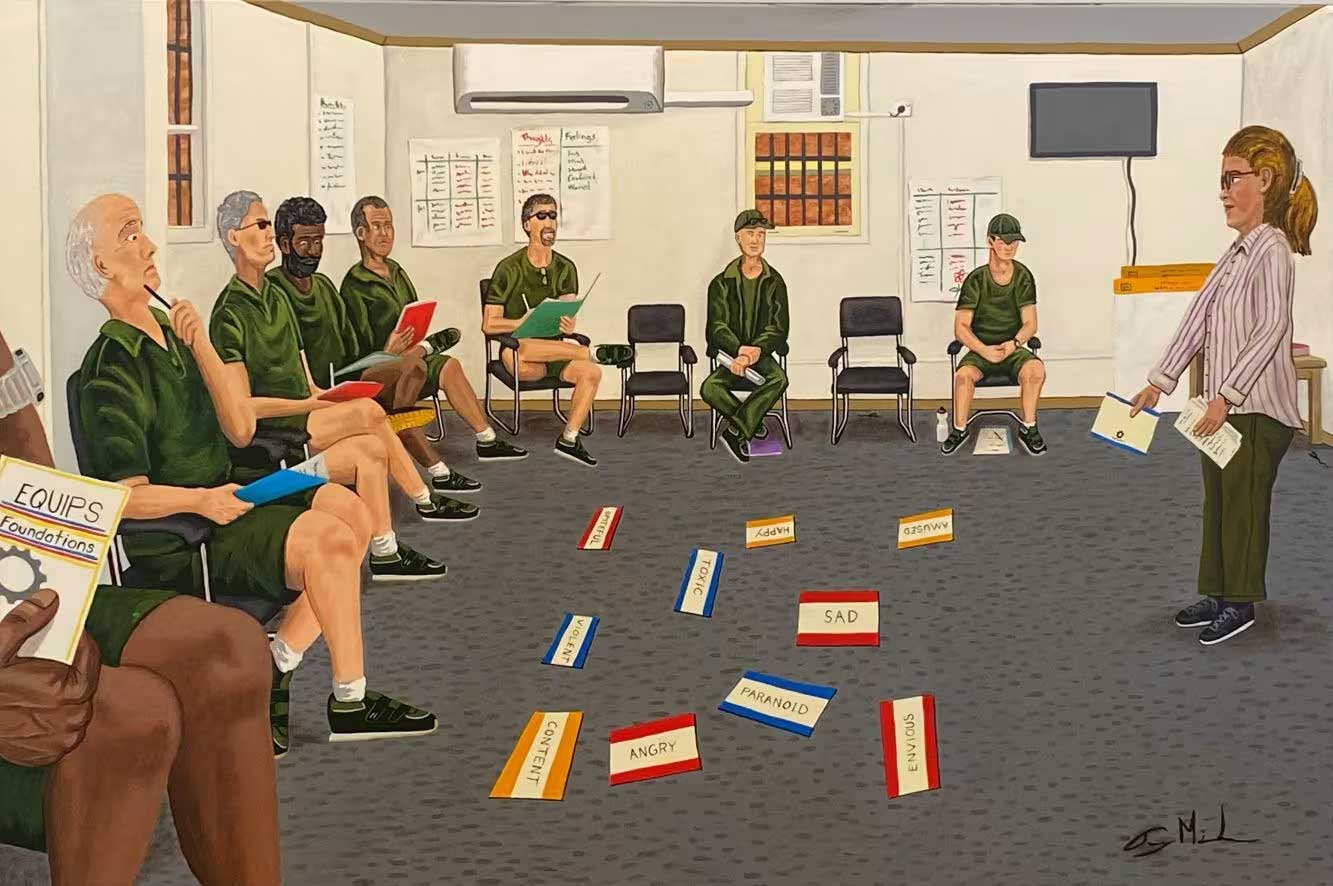
‘Courses’ by Tony, acrylic on canvas, available for purchase at Boom Gate Gallery
Originating in Goulburn Correctional Centre, we are the beginnings of a self-appointed delegation of inmates, bound together by a common goal: 'Higher Education Advocacy and Leadership’. We are H.E.A.L, and are advocating for external educational opportunities for all incarcerated people in Australia.
The nature of this open letter from us at H.E.A.L is to not only grow as a proactive inmate led organisation advocating systemic change, but also attain your encouragement and support. We are seeking the approval of both sentenced and unsentenced inmates, housed in NSW Correctional Centres, to be able to be engaged in 'External Tertiary study' via correspondence, either by a student portal which can be readily made available on inmate tablets as an approved browser site, or alternatively, mail exchange with an educational provider. Why? So, we, the incarcerated, may utilise 'dead-time', as a means to begin the vital process of self-rehabilitation, and upon release contribute to society in a meaningful way and reduce the rate of recidivism.
In the years since we have been incarcerated, housed here at Goulburn Correctional Facility for two of those years, we have had little to no opportunity to rehabilitate ourselves into better people through the medium of further education.
During our interactions with numerous inmates these past 24 months, we have learned that we are not alone in the pursuit to rehabilitate through the medium of education. There is a high interest among sentenced inmates to further educate themselves, and many have expressed that they would, if they could, undertake 'External Tertiary studies' to not only better themselves, but also benefit the community upon release by finding adequate employment. Again, this would reduce the risk of recidivism.
After we and other inmates wrote to Southern Cross University (provider for 'External Tertiary' courses in NSW, QLD, WA, and VIC) we learned that they are more than willing and able to operate throughout various prisons in NSW alongside University of Southern Queensland (UniSQ), Curtin University, and University of South Australia (UniSA) via a CSNSW security checked 'white listed website' or even through a secure digital portal which could be made available to inmates on their In Cell-Tablets. During this research period we also discovered further 'paper based' correspondence options via University of Southern Queensland and Curtin University which are currently not being offered to inmates in NSW. We would like to make note here that the cost of these courses provided by Southern Cross University, etc. will not affect in any way, shape, or form, the allocated annual budget, as prisoners are also entitled to university study on a Higher Education Contribution Scheme (HECS) and Higher Education Loan Program (HELP), nor increase the workload of the Centre's staff beyond enrolment.
It is of our understanding that Goulburn Correctional Facility, and NSW more to the point, has not yet a structural system in place to provide sentenced inmates the possibility of participating in higher education, and we completely comprehend ideas like this may at first seem a risk and/or logistically difficult, but given patience, perseverance, time, trust, along with a collaborative effort between Corrective Services NSW and inmates, it is highly probable that a Higher Educational infrastructure, like the one we are proposing may not only be established, but successful (as data suggests).
Originating in Goulburn Correctional Centre, we are the beginnings of a self-appointed delegation of inmates, bound together by a common goal: 'Higher Education Advocacy and Leadership’. We are H.E.A.L, and are advocating for external educational opportunities for all incarcerated people in Australia.
The nature of this open letter from us at H.E.A.L is to not only grow as a proactive inmate led organisation advocating systemic change, but also attain your encouragement and support. We are seeking the approval of both sentenced and unsentenced inmates, housed in NSW Correctional Centres, to be able to be engaged in 'External Tertiary study' via correspondence, either by a student portal which can be readily made available on inmate tablets as an approved browser site, or alternatively, mail exchange with an educational provider. Why? So, we, the incarcerated, may utilise 'dead-time', as a means to begin the vital process of self-rehabilitation, and upon release contribute to society in a meaningful way and reduce the rate of recidivism.
In the years since we have been incarcerated, housed here at Goulburn Correctional Facility for two of those years, we have had little to no opportunity to rehabilitate ourselves into better people through the medium of further education.
During our interactions with numerous inmates these past 24 months, we have learned that we are not alone in the pursuit to rehabilitate through the medium of education. There is a high interest among sentenced inmates to further educate themselves, and many have expressed that they would, if they could, undertake 'External Tertiary studies' to not only better themselves, but also benefit the community upon release by finding adequate employment. Again, this would reduce the risk of recidivism.
After we and other inmates wrote to Southern Cross University (provider for 'External Tertiary' courses in NSW, QLD, WA, and VIC) we learned that they are more than willing and able to operate throughout various prisons in NSW alongside University of Southern Queensland (UniSQ), Curtin University, and University of South Australia (UniSA) via a CSNSW security checked 'white listed website' or even through a secure digital portal which could be made available to inmates on their In Cell-Tablets. During this research period we also discovered further 'paper based' correspondence options via University of Southern Queensland and Curtin University which are currently not being offered to inmates in NSW. We would like to make note here that the cost of these courses provided by Southern Cross University, etc. will not affect in any way, shape, or form, the allocated annual budget, as prisoners are also entitled to university study on a Higher Education Contribution Scheme (HECS) and Higher Education Loan Program (HELP), nor increase the workload of the Centre's staff beyond enrolment.
It is of our understanding that Goulburn Correctional Facility, and NSW more to the point, has not yet a structural system in place to provide sentenced inmates the possibility of participating in higher education, and we completely comprehend ideas like this may at first seem a risk and/or logistically difficult, but given patience, perseverance, time, trust, along with a collaborative effort between Corrective Services NSW and inmates, it is highly probable that a Higher Educational infrastructure, like the one we are proposing may not only be established, but successful (as data suggests).
According to Prison Education Regional Manager Fiona McGregor, who has over 30 years experience in education (20+ in prison education), originally as a secondary school English teacher and then prison educator, manager, government advisor, consultant inspector and researcher, specialising in prisoner education in UK and Australian prisons: “Our research is telling us that the longer you continue in education and the higher the level of education you engage in, the risk of re-offending is dramatically reduced."
The 2021 Bureau of Crime statistics and research study found prisoners in traineeship programs and education were significantly less likely to reoffend after they had left jail and 16% less likely to be convicted of another crime.
Professor Penny Bourke from the University of Newcastle who has recently been appointed Chair of UNESCO stated: "I could see how life-changing higher education can be for people when they have access to it and they can participate in a really active way. We need to make it easier for people, especially from diverse backgrounds and circumstances, to access higher education."
Education in prison is about giving people the tools not to reoffend. Studies have shown recidivism in NSW is at an all-time high. We at H.E.A.L believe that by establishing a structural pathway to higher education such as 'External Tertiary study' via correspondence, either by a student portal which can be readily made available on inmate tablets as an approved browser site, or alternatively, mail exchange with educational providers, will greatly benefit the community, and inmates collectively. We hope that we can work together to make this proposal an opportunistic possibility to collectively reduce the high risk of recidivism into the future.
It’s even in the CSNSW Inmate Hand Booklet at page 44: If the courses available at the Correctional Centre do not meet your needs, inmates can participate in tertiary distance education.
If you support this proposal, we suggest you respectfully talk to the education staff at the Centre where you are currently housed to see what options you have for higher education.
Thank you for taking the time to read and consider this proposal. We look forward to your support and, hopefully hearing your thoughts on this subject matter.
Kind regards
H.E.A.L
According to Prison Education Regional Manager Fiona McGregor, who has over 30 years experience in education (20+ in prison education), originally as a secondary school English teacher and then prison educator, manager, government advisor, consultant inspector and researcher, specialising in prisoner education in UK and Australian prisons: “Our research is telling us that the longer you continue in education and the higher the level of education you engage in, the risk of re-offending is dramatically reduced."
The 2021 Bureau of Crime statistics and research study found prisoners in traineeship programs and education were significantly less likely to reoffend after they had left jail and 16% less likely to be convicted of another crime.
Professor Penny Bourke from the University of Newcastle who has recently been appointed Chair of UNESCO stated: "I could see how life-changing higher education can be for people when they have access to it and they can participate in a really active way. We need to make it easier for people, especially from diverse backgrounds and circumstances, to access higher education."
Education in prison is about giving people the tools not to reoffend. Studies have shown recidivism in NSW is at an all-time high. We at H.E.A.L believe that by establishing a structural pathway to higher education such as 'External Tertiary study' via correspondence, either by a student portal which can be readily made available on inmate tablets as an approved browser site, or alternatively, mail exchange with educational providers, will greatly benefit the community, and inmates collectively. We hope that we can work together to make this proposal an opportunistic possibility to collectively reduce the high risk of recidivism into the future.
It’s even in the CSNSW Inmate Hand Booklet at page 44: If the courses available at the Correctional Centre do not meet your needs, inmates can participate in tertiary distance education.
If you support this proposal, we suggest you respectfully talk to the education staff at the Centre where you are currently housed to see what options you have for higher education.
Thank you for taking the time to read and consider this proposal. We look forward to your support and, hopefully hearing your thoughts on this subject matter.
Kind regards
H.E.A.L
What I Learned After Losing Everything to Addiction
By Jeremy
I’m currently 45 years old and I have spent 19 years of my life in NSW jails, albeit in instalments (not all in one go), because I kept falling for the traps of evil.
Experiences
ISSUE NO. 23
•
4 MIN READ
Calling All Inmates!
By Anonymous
Who would have thought prison would be so noisy. No, not the inmates (although they can be a tad rambunctious at times) – I’m talking about all the bloody announcements!
Experiences
ISSUE NO. 23
•
2 MIN READ
Loving Someone In Prison
By Gabrielle
My partner gave me 24 frozen roses the Valentine’s Day he went to prison.
Experiences
ISSUE NO. 23
•
3 MIN READ
Day Release: Freedom Whiplash
By Jonathan
My first day out was surreal. Just walking out the gate, I felt the weight slip from my shoulders. I told Mum with a smile, “I’m a free man, for today.”
Experiences