Welcome to About Time

About Time is the national newspaper for Australian prisons and detention facilities

Your browser window currently does not have enough height, or is zoomed in too far to view our website content correctly. Once the window reaches the minimum required height or zoom percentage, the content will display automatically.

Alternatively, you can learn more via the links below.

Donations via GiveNow

Email

Instagram

LinkedIn

ISSUE NO. 26
+
Sections
September 2026
Donate Here

Mob

Just Keep Turning Up

Through scholarships, mentoring and culture, the GO Foundation is backing First Nations young people to stay in school and build new pathways.
Denham Sadler is the Chief Reporter and Assistant Editor at About Time.

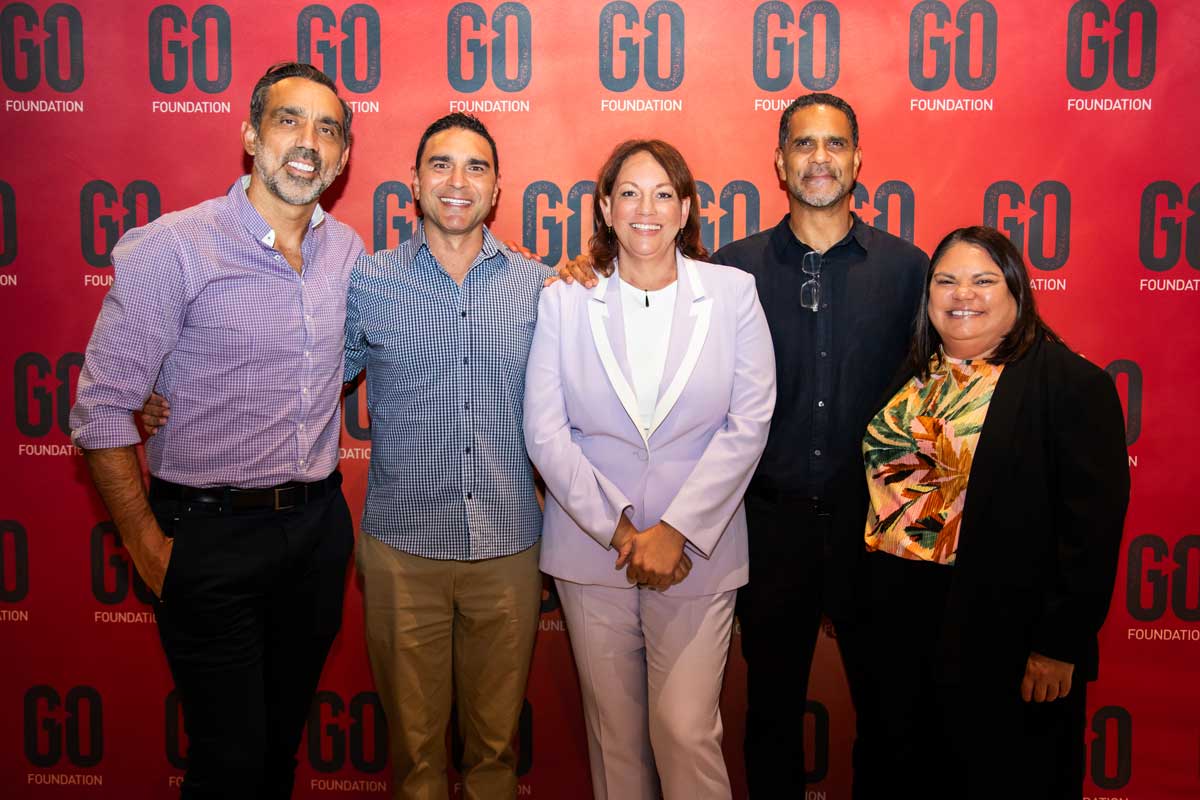
You’ve probably heard of AFL legends Adam Goodes and Michael O’Loughlin. But what you might not know, is that they also started their own charity called the GO Foundation.

The foundation provides cultural and aspirational mentoring, access opportunities and financial support for education for young First Nations people.

About Time spoke to proud Wiradjudri man and GO Foundation Deputy CEO Mark Heiss and proud Wiilman Noongar man Tyran Hill, who received a scholarship from the foundation in 2020 and is now the organisation’s scholarships program manager in Adelaide.

Mark Heiss

AT: Can you tell us about the work the GO Foundation does?

Mark: GO is a First Nations-led and governed organisation. We have a vision to empower through educational scholarships and  cultural and aspirational mentoring.

We’ve awarded over 2,300 scholarships in the last 17 years and currently support 670 young people on scholarships.

How important is education and getting started early with that? What difference can it make to someone’s life?

It’s super important –we believe that education is one of the key game-changers.

If a young person completes their education, they’ll have higher literacy rates, be employed for a longer period of time, and have higher levels of home ownership.

Just keep turning up. The impact of education on people’s lives just hits so many social indicators.

How have you seen people change as they’ve taken part in the program?

We had a young fella in Adelaide who wasn’t truanting school, but was taking the mickey when he had a chance. And he sat down with our co-founders, Adam and Michael, and this young fella was in Year Five. And they said, “Mate, you have to keep coming to school”. That one conversation meant that in Year Six, he got the award for 100 per cent attendance.

He has spoken at our graduation and talked about how that one conversation made a difference to his outlook on being at school and how he could see the two paths and where he could end up: “If I can go on this path, I can be like Uncle Adam and Uncle Mickey and be successful.”

What’s your message to Mob currently in prison?

Aboriginal people have been in Australia for a long time, and they’ve been through lots of hard times. We’re talking millennia. And I believe our ancestors are looking over us. So if you can think that, “well, my ancestors have been through this, what would they do in a particular situation and what would they be proud of me doing?”, that can be a good lens to think about decisions and behaviours.

In the journey on the way out of incarceration, it can be a mantra to live by: “What would my ancestors be proud of?”

The second piece is around education. No matter where you are, you can be in a learning scenario, and by learning, whether it’s about your connection to culture or learning through more formal means, that’s going to make a difference to what happens when you get out.

Tyran Hill

AT: You received a scholarship. What’s it like being on the other side now and working with the kids and young adults?

Tyran: It’s definitely a full circle moment. I’ve been working for GO for almost four years now and I’ve worked with a number of the same kids since I started, so seeing them grow up has been really special, and watching them grow from little kids to emerging leaders, it’s pretty inspiring and makes you super proud.

How important is that focus on education from a young age?

Education opens doors for everything.

Books aren’t for everyone and school is not for everyone, but as long as you’re rocking up and giving it your best shot, hopefully we can work towards finding something that you do really like and enjoy, and something that’s going to be a career for you for a long time.

What’s your message to Mob currently in prison?

Just remember the importance of culture. Sometimes there has been a lot of intergenerational trauma and intergenerational incarceration and circumstances that have contributed to that.

If we can keep our connection to culture strong and keep striving to educate ourselves and make the best for ourselves, hopefully we can really work towards breaking that cycle and inspiring our next generation so they don’t have to go through what everyone else has had to go through before us.

You’ve probably heard of AFL legends Adam Goodes and Michael O’Loughlin. But what you might not know, is that they also started their own charity called the GO Foundation.

The foundation provides cultural and aspirational mentoring, access opportunities and financial support for education for young First Nations people.

About Time spoke to proud Wiradjudri man and GO Foundation Deputy CEO Mark Heiss and proud Wiilman Noongar man Tyran Hill, who received a scholarship from the foundation in 2020 and is now the organisation’s scholarships program manager in Adelaide.

Mark Heiss

AT: Can you tell us about the work the GO Foundation does?

Mark: GO is a First Nations-led and governed organisation. We have a vision to empower through educational scholarships and  cultural and aspirational mentoring.

We’ve awarded over 2,300 scholarships in the last 17 years and currently support 670 young people on scholarships.

How important is education and getting started early with that? What difference can it make to someone’s life?

It’s super important –we believe that education is one of the key game-changers.

If a young person completes their education, they’ll have higher literacy rates, be employed for a longer period of time, and have higher levels of home ownership.

Just keep turning up. The impact of education on people’s lives just hits so many social indicators.

How have you seen people change as they’ve taken part in the program?

We had a young fella in Adelaide who wasn’t truanting school, but was taking the mickey when he had a chance. And he sat down with our co-founders, Adam and Michael, and this young fella was in Year Five. And they said, “Mate, you have to keep coming to school”. That one conversation meant that in Year Six, he got the award for 100 per cent attendance.

He has spoken at our graduation and talked about how that one conversation made a difference to his outlook on being at school and how he could see the two paths and where he could end up: “If I can go on this path, I can be like Uncle Adam and Uncle Mickey and be successful.”

What’s your message to Mob currently in prison?

Aboriginal people have been in Australia for a long time, and they’ve been through lots of hard times. We’re talking millennia. And I believe our ancestors are looking over us. So if you can think that, “well, my ancestors have been through this, what would they do in a particular situation and what would they be proud of me doing?”, that can be a good lens to think about decisions and behaviours.

In the journey on the way out of incarceration, it can be a mantra to live by: “What would my ancestors be proud of?”

The second piece is around education. No matter where you are, you can be in a learning scenario, and by learning, whether it’s about your connection to culture or learning through more formal means, that’s going to make a difference to what happens when you get out.

Tyran Hill

AT: You received a scholarship. What’s it like being on the other side now and working with the kids and young adults?

Tyran: It’s definitely a full circle moment. I’ve been working for GO for almost four years now and I’ve worked with a number of the same kids since I started, so seeing them grow up has been really special, and watching them grow from little kids to emerging leaders, it’s pretty inspiring and makes you super proud.

How important is that focus on education from a young age?

Education opens doors for everything.

Books aren’t for everyone and school is not for everyone, but as long as you’re rocking up and giving it your best shot, hopefully we can work towards finding something that you do really like and enjoy, and something that’s going to be a career for you for a long time.

What’s your message to Mob currently in prison?

Just remember the importance of culture. Sometimes there has been a lot of intergenerational trauma and intergenerational incarceration and circumstances that have contributed to that.

If we can keep our connection to culture strong and keep striving to educate ourselves and make the best for ourselves, hopefully we can really work towards breaking that cycle and inspiring our next generation so they don’t have to go through what everyone else has had to go through before us.

This
article
was originally printed in the
September 2026
edition of About Time.
By Boom Gate Gallery

Most of the art featured at Boom Gate Gallery is made at Long Bay Gaol, with some coming from other prisons in NSW.

ISSUE NO. 26
2 MIN READ
By NAAJA

NAAJA has a 50-year history of serving Aboriginal Territorians as they navigate the justice system.

ISSUE NO. 25
3 MIN READ
By Denham Sadler

Tracy was one of many women released from prison straight into homelessness. Thanks to the Homeward Sisters program, Tracy was able to secure priority housing that meets her needs.

ISSUE NO. 24
3 MIN READ
By Denham Sadler

First Nations music legend Roger Knox has played everywhere from huge music festivals in the USA to the Sydney Opera House. But he says the shows that mean the most to him are the ones he played in prisons around Australia.

ISSUE NO. 24
4 MIN READ