Learn How to Speak First Nations Languages!
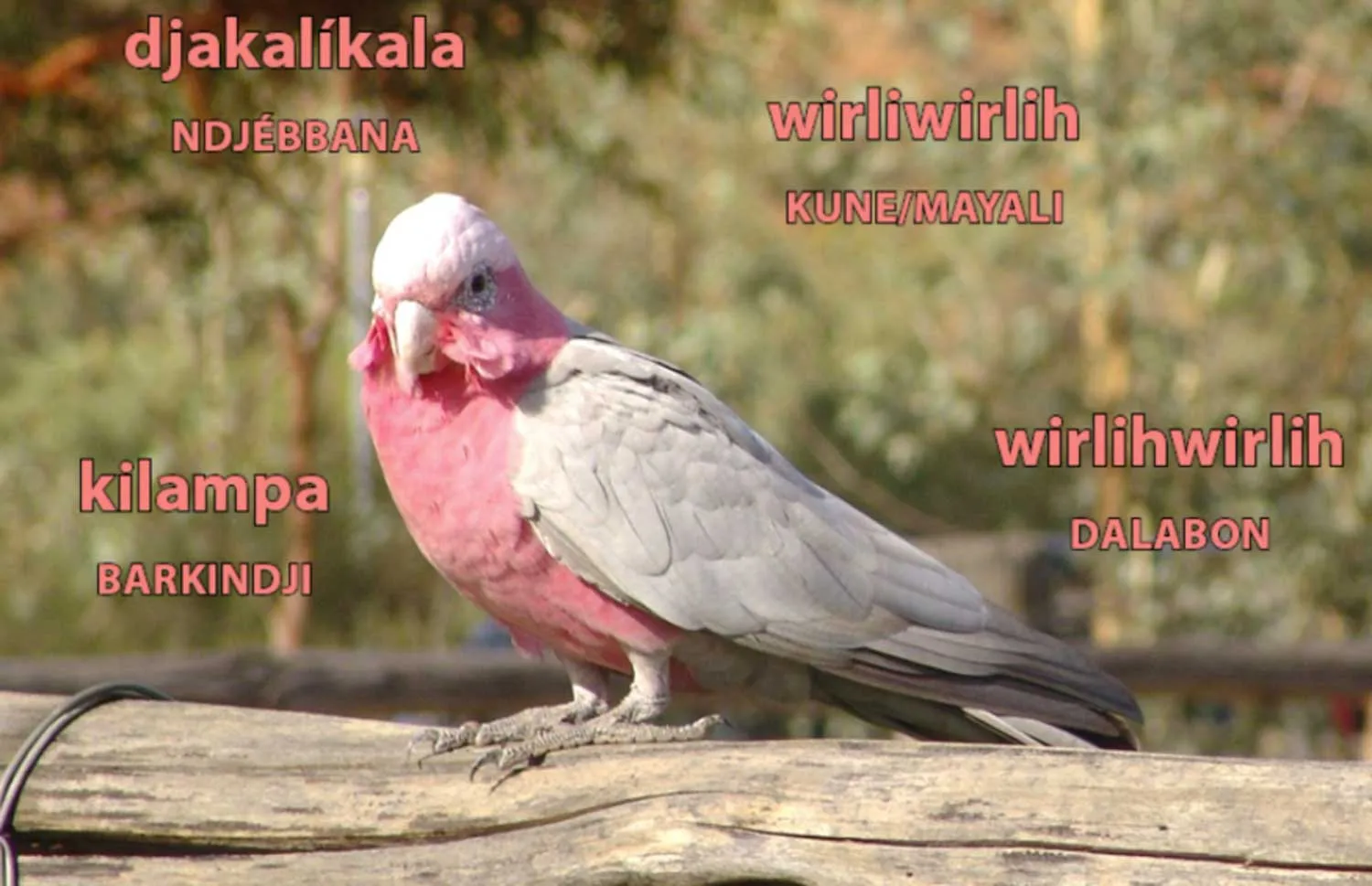
How to say ‘galah’ in First Nations languages around the country


Your browser window currently does not have enough height, or is zoomed in too far to view our website content correctly. Once the window reaches the minimum required height or zoom percentage, the content will display automatically.
Alternatively, you can learn more via the links below.
If you drive from Melbourne to Sydney, you will travel through 10 different First Nations language groups. And there’s the same number between Melbourne and Adelaide.
Before European colonisation in 1788, the First Peoples of Australia spoke as many as 800 Indigenous languages, depending on how you divide languages and dialects.
The languages of Indigenous Australia belong to a number of language ‘families’: groups of languages that are historically related and share certain features.
The languages spoken in the rest of Australia (northern WA, northern QLD and the NT) belong to perhaps as many as 24 other distinct language families, which are known collectively as ‘Non-Pama-Nyungan’.
People from around Australia have shared some words from their language with us. The 50 Words Map is a resource that allows people to see and hear some words from the languages of the land where they live, work and go to school.
It shows the diversity of Indigenous languages spoken around Australia. It’s not complete yet, but there’s lots you can learn already!
Think how easily many of us can recall simple greetings in these European languages. Now the same could be true for the languages of our own country, the languages of the First Nation.
Learning more about the languages of Indigenous Australia provides significant insights into culture, as many important aspects of local culture are coded into languages.
Creating a resource for people to learn and appreciate the diversity of our Indigenous languages is important for both speakers of these languages and for the general public.
Seven years after launch, we have received and published 50 words in 100 languages.


If you drive from Melbourne to Sydney, you will travel through 10 different First Nations language groups. And there’s the same number between Melbourne and Adelaide.
Before European colonisation in 1788, the First Peoples of Australia spoke as many as 800 Indigenous languages, depending on how you divide languages and dialects.
The languages of Indigenous Australia belong to a number of language ‘families’: groups of languages that are historically related and share certain features.
The languages spoken in the rest of Australia (northern WA, northern QLD and the NT) belong to perhaps as many as 24 other distinct language families, which are known collectively as ‘Non-Pama-Nyungan’.
People from around Australia have shared some words from their language with us. The 50 Words Map is a resource that allows people to see and hear some words from the languages of the land where they live, work and go to school.
It shows the diversity of Indigenous languages spoken around Australia. It’s not complete yet, but there’s lots you can learn already!
Think how easily many of us can recall simple greetings in these European languages. Now the same could be true for the languages of our own country, the languages of the First Nation.
Learning more about the languages of Indigenous Australia provides significant insights into culture, as many important aspects of local culture are coded into languages.
Creating a resource for people to learn and appreciate the diversity of our Indigenous languages is important for both speakers of these languages and for the general public.
Seven years after launch, we have received and published 50 words in 100 languages.
Origami is the Japanese art of paper folding. It allows you to turn a flat piece of paper into nearly anything you can think of, like an animal, flower or a hat.
“There is no happiness on earth equal to that of liberty regained” – more wisdom from Don Quixote
Astrology and the interpretation of the stars and planets have been around for millennia. First originating in ancient Mesopotamia, astrology began by using the stars to decipher messages from the gods.
Including pieces of knowledge about lungs, the three-time Melbourne cup winning mare Makybe Diva, spiral staircases and more.