


Donate Here
•
Experiences
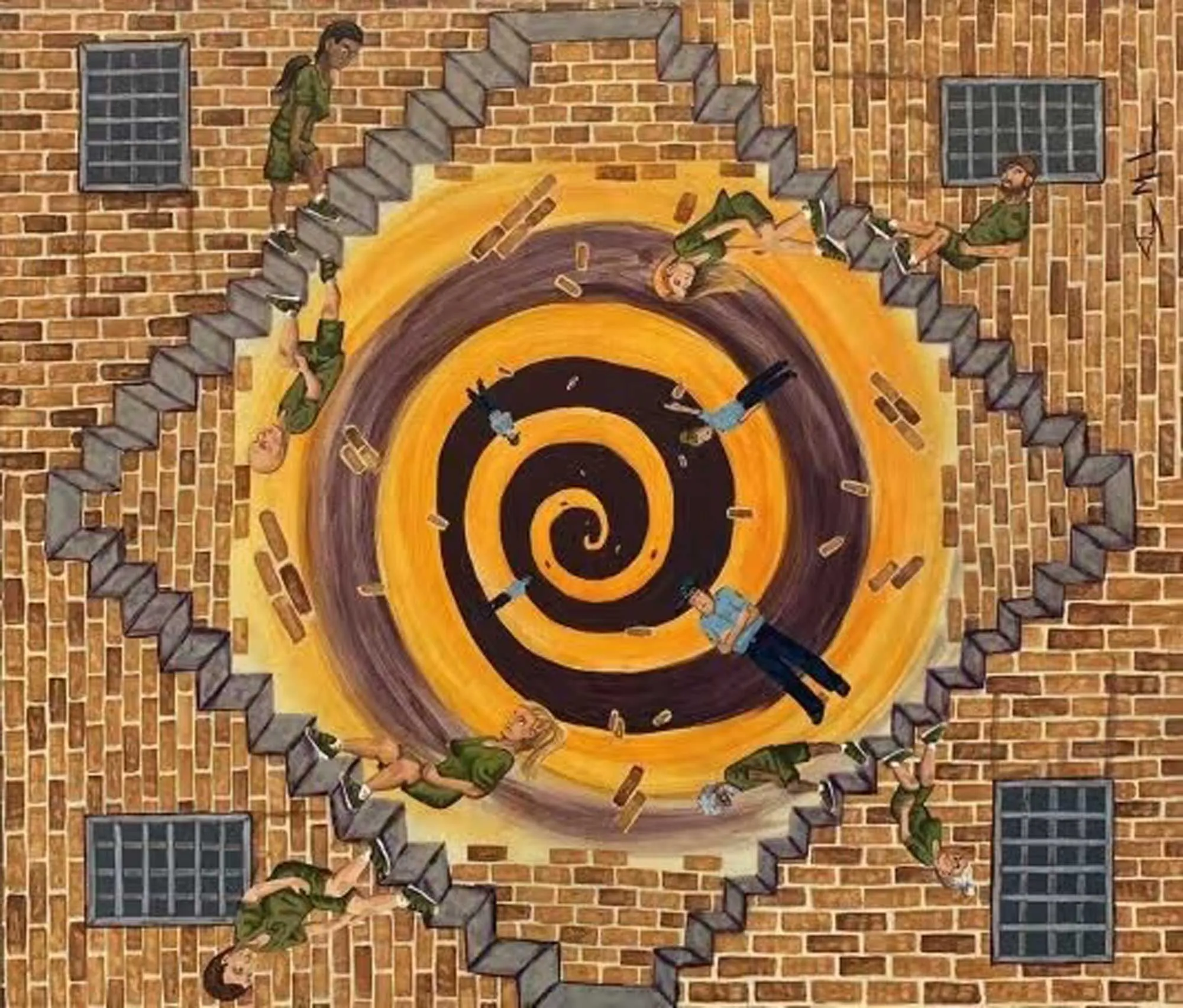
‘Insanity’ by Tony, Boom Gate Gallery
You can ‘pass time’, ‘keep time’, ‘waste time’ and ‘lose time’.
You can be ‘ahead of time’ or ‘out of time’, have ‘good times’ and ‘bad times’, or even ‘the time of your life’. And of course, you can do ‘hard time’. Time is a river, flowing in but a single direction, sweeping us ever-forward to our allotted fate.
Time is a key element of human existence. The Oxford Dictionary of English defines time as the “indefinite continued progress of existence and events in the past, present and future regarded as a whole”. Einstein defined ‘spacetime’ in his theories of general and special relativity as the four dimensional medium in which the universe exists, measured by length, width, height and time.
Philosophers have argued about the nature of time for centuries. For instance, whether time is independent of events; or that without events to mark its passage, time is little more that an unobservable abstract. Aristotle described time as ‘the measure of motion’ (or change). Which is probably why time seems to stand still when you’re stuck in the same cell, day after day, with nothing to do.
There are three types of time: perceptual (right now); conceptual (all other times – past, present and future) and subjective (time from in individual’s viewpoint).
Each person perceives time differently at different stages in their life. As children, minutes can seem like hours. But as we age we become more aware of time – and begin to budget it. As our lives become more complex and more filled with responsibility, we are even held hostage by it. And as we get older, we begin to covet it.
In prison, time can be the weight that crushes the life out of you; thinking about the years of incarceration ahead, or the years that have passed since you’ve seen home and family.
After being incarcerated for a little over three years (not yet at my halfway point) I’ve found it’s better to live one day at a time, trying not to look further than a week ahead. I find it comforting to cross each day off my calendar (more a measure of ‘days passed’ than ‘days left’); while other inmates have told me it seems to make their time feel longer.
In prison we are advised: “All you have is time” and transitioning from a ‘time poor’ to ‘time rich’ environment can be a significant adjustment: How to fill all that additional time?
You can work, which kills up to five hours a day (sometimes longer if you can get overtime) – depending on your job.
You can sign up for education opportunities. Many inmates improve their english and maths skills, while some complete tertiary qualifications through distance learning.
You can work on your fitness in the gym, playing sport, or just walking around the yard.
You can catch up on all those books you were “getting around to reading” on the outside – there are worlds of entertainment available at the library.
Or you could explore your creative side; painting, drawing, writing, hobby-craft, or playing an instrument – activities that can provide a sense of satisfaction and accomplishment.
Some inmates play endless games of scrabble, cards, or pool, or simply go to bed early and sleep ten to twelve hours a day.
The most useful skill in prison is definitely the ability to keep yourself amused.
All inmates are time travellers. We leave our world and go back to the 90s (no internet, no smartphones, no streaming), then eventually emerge into the ‘future’. If enough time has passed, this new world may be scarily different.
My advice? Each new dawn is one day closer to release. Focus on the moment and time will take care of itself. It’s not the amount of time you’ve got – it’s how you use it.
In prison we are advised: “All you have is time” and transitioning from a ‘time poor’ to ‘time rich’ environment can be a significant adjustment: How to fill all that additional time?
You can work, which kills up to five hours a day (sometimes longer if you can get overtime) – depending on your job.
You can sign up for education opportunities. Many inmates improve their english and maths skills, while some complete tertiary qualifications through distance learning.
You can work on your fitness in the gym, playing sport, or just walking around the yard.
You can catch up on all those books you were “getting around to reading” on the outside – there are worlds of entertainment available at the library.
Or you could explore your creative side; painting, drawing, writing, hobby-craft, or playing an instrument – activities that can provide a sense of satisfaction and accomplishment.
Some inmates play endless games of scrabble, cards, or pool, or simply go to bed early and sleep ten to twelve hours a day.
The most useful skill in prison is definitely the ability to keep yourself amused.
All inmates are time travellers. We leave our world and go back to the 90s (no internet, no smartphones, no streaming), then eventually emerge into the ‘future’. If enough time has passed, this new world may be scarily different.
My advice? Each new dawn is one day closer to release. Focus on the moment and time will take care of itself. It’s not the amount of time you’ve got – it’s how you use it.
Date Published
July 7, 2026
By David
My name is David. I am a proud Yorta Yorta man currently locked up in Victoria.
ISSUE NO. 26
•
3 MIN READ
By Ivan
It was mid-afternoon in the Port Campbell area, with a southerly wind blowing, and Henry and I were just about to leave the Boggy Creek Café.
ISSUE NO. 26
•
3 MIN READ
By Gary Griffiths
Father’s Day can bring pride, guilt, sadness, hope, or all of them at once, and being in jail doesn’t stop that.
ISSUE NO. 26
•
2 MIN READ
By Kelly Flanagan
Being kind is something I find really challenging at times.
ISSUE NO. 25
•
2 MIN READ